
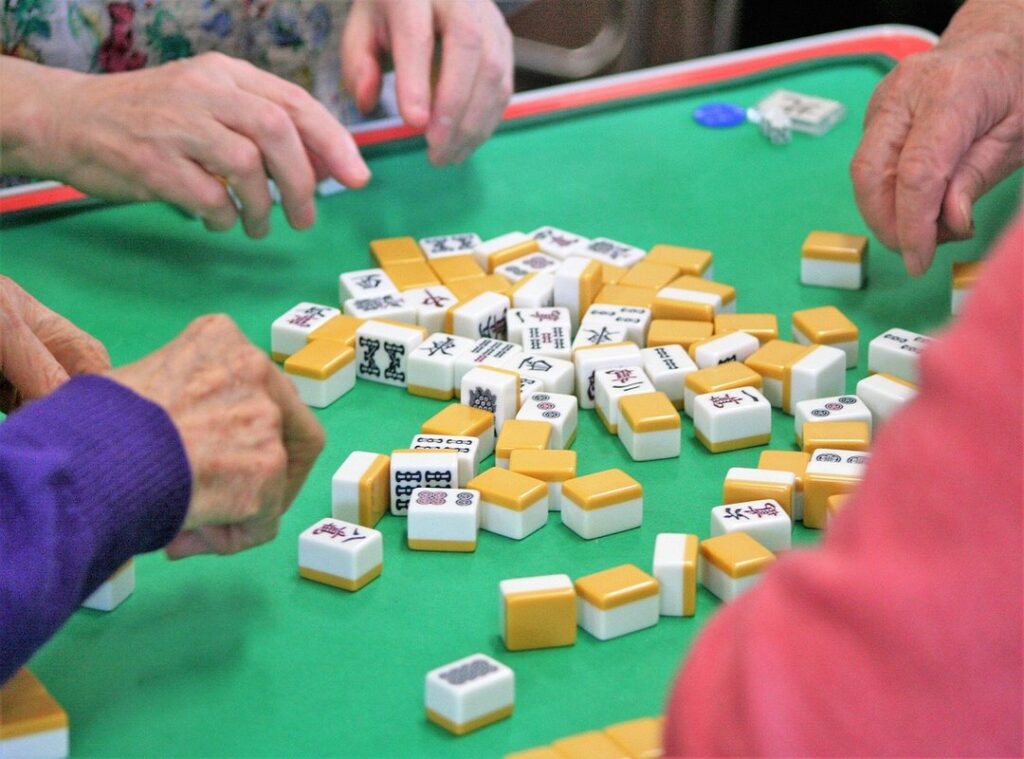
Ever felt like you’re missing out on a game that’s both fun and mentally stimulating? Let me introduce you to mahjong. It’s a tile-based game that combines skill, strategy, and a bit of luck.
Originating from China, it’s more than just a pastime.
Mahjong is especially popular among seniors and AARP members. Why, and it offers social and cognitive benefits.
Plus, it’s a great way to connect with others.
In this guide, I’ll break down the basics of mahjong in a simple, step-by-step way. No prior knowledge needed. By the end, you’ll be ready to play your first round.
Trust me, it’s easier than you think.
Getting to Know Your Tiles: The Mahjong Set Explained
When you first look at a Mahjong set, it can seem overwhelming. But don’t worry, I’ll break it down for you.
A standard Mahjong set has 144 tiles. That’s a lot, but they’re divided into different types, making it easier to understand.
First, there are the three main suits: Bamboos (Bams), Characters (Cracks), and Dots (Circles). Each suit runs from numbers 1 to 9. Bams usually have bamboo sticks, Cracks have Chinese characters, and Dots have circles.
Simple, right?
Next up, we have the Honor tiles, and these are split into Winds and Dragons. The Winds are East, South, West, and North.
The Dragons come in Red, Green, and White. The Red Dragon is often a blank tile with a red frame or character.
Then there are the Bonus tiles, like Flowers and Seasons. Their use can vary depending on the rules you’re playing. Some games include them, others don’t.
It’s a bit flexible.
You might be thinking, “How am I supposed to remember all of this?” Don’t stress. Memorizing every tile isn’t necessary at first, and recognition will come with practice.
And if you’re part of mahjong aarp, you’ll get plenty of chances to play and learn. Just keep playing, and you’ll get the hang of it.
The Object of the Game: How to Declare ‘Mahjong!’
I remember the first time I played mahjong. I was so confused about what I was supposed to do. But once I got the hang of it, it became a lot clearer.
The primary goal is simple: be the first player to form a complete hand of 14 tiles. This hand consists of four sets and one pair. It’s all about strategy and a bit of luck.
A pair is two identical tiles. For example, two 8 of Bamboos or two East Wind tiles. Easy enough, right?
Now, let’s talk about the three types of sets you can form. There’s a Pung, which is three identical tiles. Then there’s a Chow, a sequence of three numbers in the same suit, like 3-4-5 of Dots.
Lastly, there’s a Kong, which is four identical tiles. Each set has its own unique value and can change the game quickly.
A winning hand is almost always composed of four of these sets—any combination of Pungs, Chows, or Kongs—plus one pair. It’s all about building these specific combinations.
Imagine a complete winning hand: [Pung of 3 Bams], [Chow of 4-5-6 Dots], [Pung of Red Dragons], [Kong of 7 Cracks], [Pair of North Winds]. That’s what you’re aiming for. mahjong aarp
The entire game revolves around drawing and discarding tiles to build these combinations. You have to be strategic and quick.
One time, I was playing with my friends, and we were using a mahjong aarp set. The game was intense, and every tile draw felt like it could make or break the game. It’s that kind of excitement that keeps me coming back.
So, next time you sit down to play, remember the goal. Focus on forming those sets and pairs, and and most importantly, have fun!
Playing Your First Round: A Step-by-Step Walkthrough

Setting up the game is pretty straightforward. Shuffle the tiles face-down and build the four walls.
Who gets to be the first dealer, or East Wind? It’s usually determined by a dice roll. The highest roller becomes East, and players are seated in a counter-clockwise order.
Now, let’s talk about dealing, and each player receives 13 tiles. The dealer, however, starts with 14.
This gives them a slight edge, which I think is fair since they have to deal with the extra responsibility.
The flow of a turn is simple, and the dealer discards a tile to begin. Play then proceeds counter-clockwise.
On your turn, you draw one tile from the wall. Then, discard one tile from your hand, placing it face-up in the center. This is the core action.
Claiming a discarded tile to form a Pung, Chow, or Kong can interrupt the normal turn order. It’s a strategic move that can really change the game.
I’ve seen many players get too excited about claiming tiles. My advice, and be selective.
Only claim when it significantly improves your hand. Otherwise, you might just be giving away your strategy.
Playing mahjong aarp can be a bit different, but the basics remain the same. It’s all about knowing when to hold ’em and when to fold ’em.
More Than a Game: Why Mahjong is a Perfect Fit for AARP Members
Mahjong is more than just a game; it’s a perfect fit for the AARP community. It keeps the mind sharp by requiring memory, strategy, and pattern recognition.
The social aspect can’t be overlooked. It’s a fantastic way to connect with friends, family, or meet new people in a community setting.
AARP members often look for activities that are both engaging and low-stress. Mahjong fits the bill perfectly.
Online versions, like AARP’s own Mahjongg Solitaire games, make it easy to practice and enjoy anytime.
It’s a highly enjoyable pastime that offers both relaxation and mental engagement.
Mahjong aarp is a combination that brings together the best of both worlds—cognitive benefits and social connection.
Your Next Move: Getting Started with Mahjong
We’ve covered the core concepts: understanding the tiles, the goal of making sets and a pair, and the basic flow of play. The rules may seem complex at first, but they become intuitive after just a few games.
Try an online mahjong aarp game to get a feel for the rules without pressure. This can be a great way to practice and build your confidence.
You can also look for local clubs, community centers, or groups of friends to start playing in person. The world of Mahjong is waiting for you—it’s time to draw your first tile!
 There is a specific skill involved in explaining something clearly — one that is completely separate from actually knowing the subject. Suzanne Reillyownser has both. They has spent years working with nutrition optimization plans in a hands-on capacity, and an equal amount of time figuring out how to translate that experience into writing that people with different backgrounds can actually absorb and use.
Suzanne tends to approach complex subjects — Nutrition Optimization Plans, Bikim High-Intensity Intervals, Fitness Routines and Fundamentals being good examples — by starting with what the reader already knows, then building outward from there rather than dropping them in the deep end. It sounds like a small thing. In practice it makes a significant difference in whether someone finishes the article or abandons it halfway through. They is also good at knowing when to stop — a surprisingly underrated skill. Some writers bury useful information under so many caveats and qualifications that the point disappears. Suzanne knows where the point is and gets there without too many detours.
The practical effect of all this is that people who read Suzanne's work tend to come away actually capable of doing something with it. Not just vaguely informed — actually capable. For a writer working in nutrition optimization plans, that is probably the best possible outcome, and it's the standard Suzanne holds they's own work to.
There is a specific skill involved in explaining something clearly — one that is completely separate from actually knowing the subject. Suzanne Reillyownser has both. They has spent years working with nutrition optimization plans in a hands-on capacity, and an equal amount of time figuring out how to translate that experience into writing that people with different backgrounds can actually absorb and use.
Suzanne tends to approach complex subjects — Nutrition Optimization Plans, Bikim High-Intensity Intervals, Fitness Routines and Fundamentals being good examples — by starting with what the reader already knows, then building outward from there rather than dropping them in the deep end. It sounds like a small thing. In practice it makes a significant difference in whether someone finishes the article or abandons it halfway through. They is also good at knowing when to stop — a surprisingly underrated skill. Some writers bury useful information under so many caveats and qualifications that the point disappears. Suzanne knows where the point is and gets there without too many detours.
The practical effect of all this is that people who read Suzanne's work tend to come away actually capable of doing something with it. Not just vaguely informed — actually capable. For a writer working in nutrition optimization plans, that is probably the best possible outcome, and it's the standard Suzanne holds they's own work to.